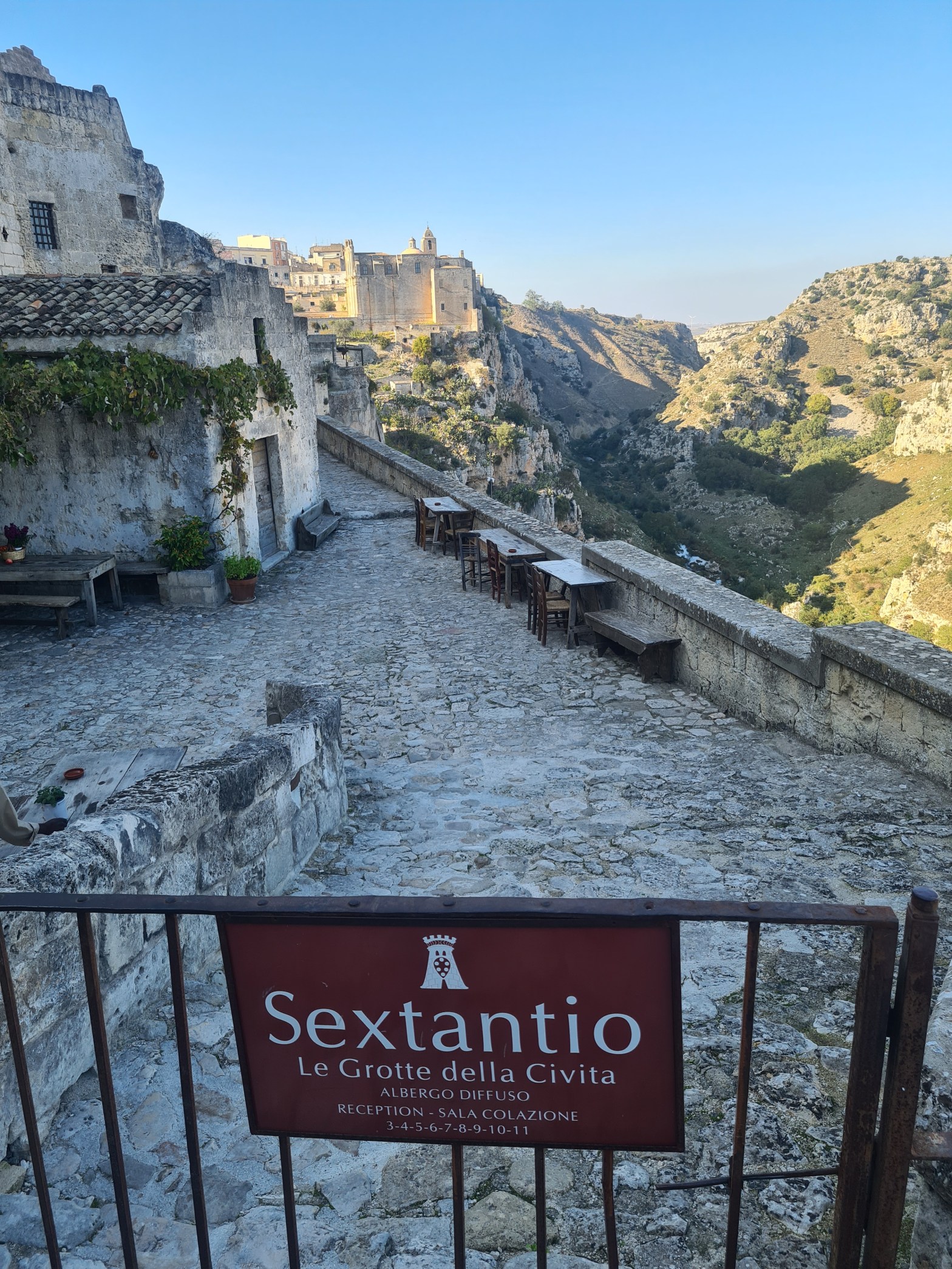
Just one hour’s drive from Bari, crossing the border of Puglia into the region of Basilicata, is a city that Italy forgot for almost four decades. The history of Matera is fascinating; it was famously once labelled “Italy’s shame” for the squalid conditions in which thousands of families lived, in caves carved into the cliffs with poor sanitation and rife with disease.
The entire city of 16,000 people was evacuated in the 1950s following a visit by shocked president Alcide de Gasperi, and was left abandoned until the 1990s when Government incentive schemes began encouraging families back to Matera. Rather than sweep this dark past under the carpet, locals have embraced the opportunity to keep Matera’s heritage alive and to share what life was like for the families who lived here before. Matera was named a World Heritage Site in 1993 and European Capital of Culture in 2019, recognising the historical and cultural significance of its journey.
We drive along motorway and through countryside until suddenly an outcrop of rocks appears and gives way to a sprawling valley of grey and white buildings: the Sassi (‘stones’ – old town) of Matera. It feels like arriving onto a film set, which isn’t so surprising as this has been the set for blockbusters such as The Passion of the Christ and No Time to Die (think of the epic chase scene through alleyways and over rooftops).
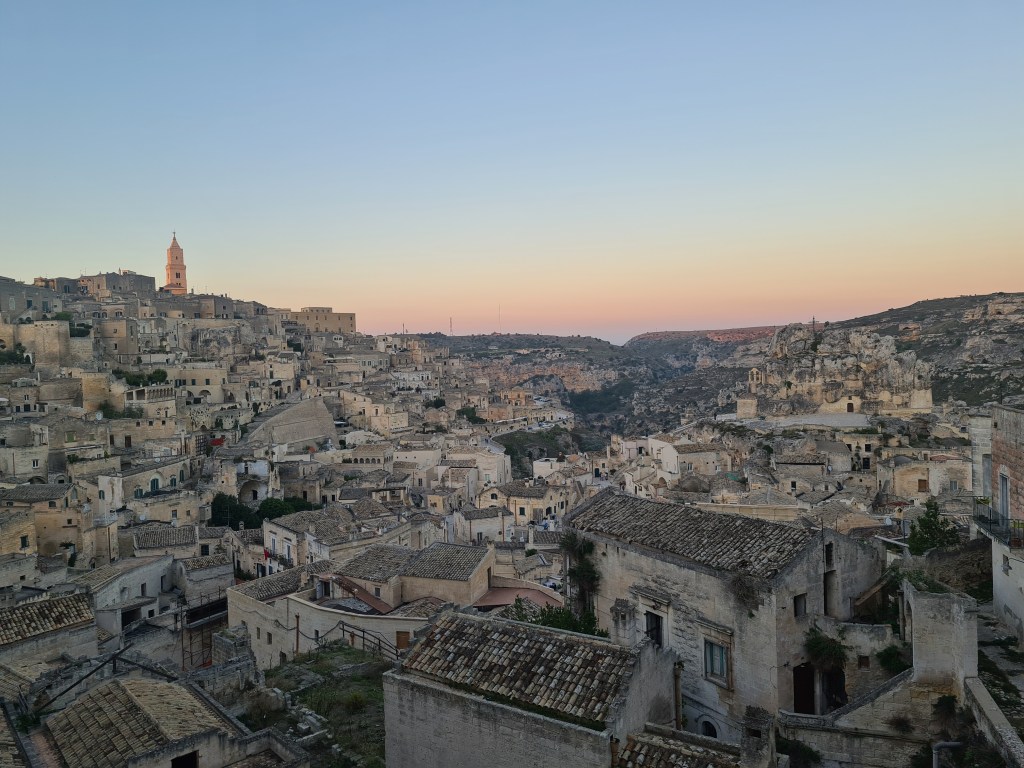
Matera is well primed for tourism these days, but we arrive at the end of high season and it feels like we’re part of only a handful of tourists. There are no queues or a need to make reservations; there’s always a free table at whichever trattoria you fancy. We’re certainly not complaining but it is surprising. Here you have the chance to stay in caves that were inhabited 9000 years ago and eat pasta with the view of a World Heritage Site around you. It’s surprising.
There are plenty of great hotel options in Matera, many of which offer the experience of staying in one of the caves right in the heart of the Sassi. There is a good range and it is very possible to do this on a lower budget, as well as more luxurious options. For us, there was really only one choice: Sextantio le Grotte della Civita. Located in the oldest part of the Sassi, le Grotte della Civita faces directly onto the ravine of the Murgia national park. It’s a breathtaking location with the labyrinth of the town on one side and the dramatic drop of the cliffs on the other.
On arrival, it’s clear that this will be a full experience. Our host starts with a guided tour of the communal areas – a former church transformed into a reception and dining hall – before giving a detailed description of the history of our room and the process of its renovation. Sextantio owns two historical hotels in Italy (the other is Sextantio Albergo Diffuso in Abruzzo) and the restoration of le Grotte della Civita’s caves has been carried out an effort to respect the story of the site’s past life while creating a space that provides luxury comfort for guests.
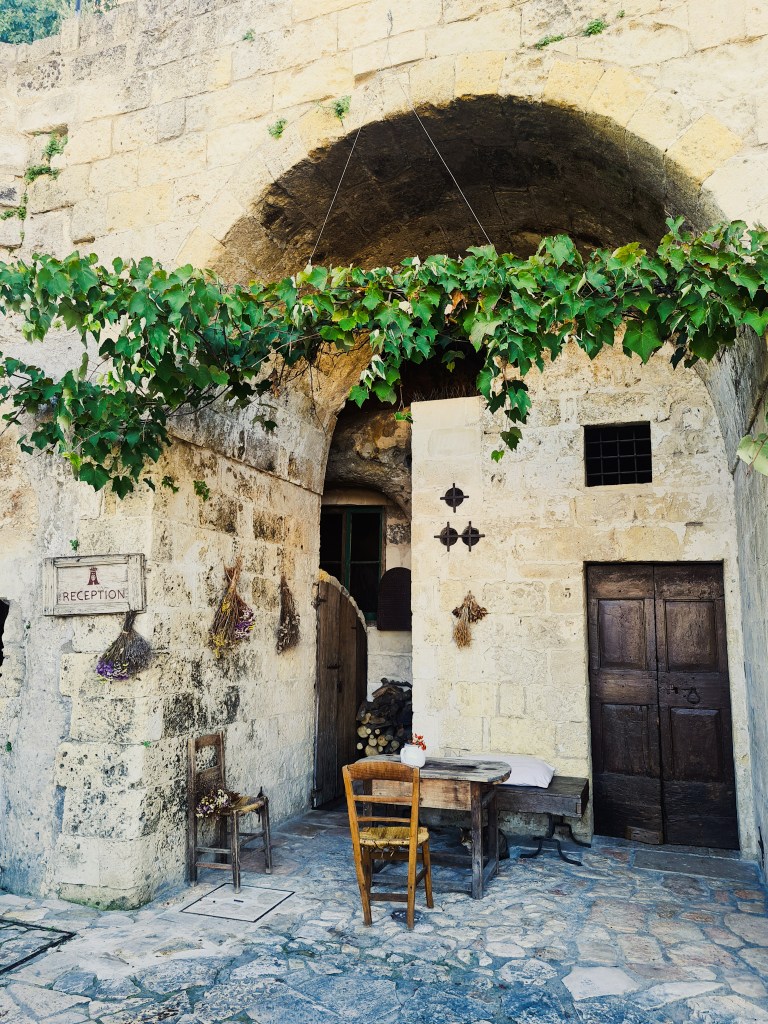
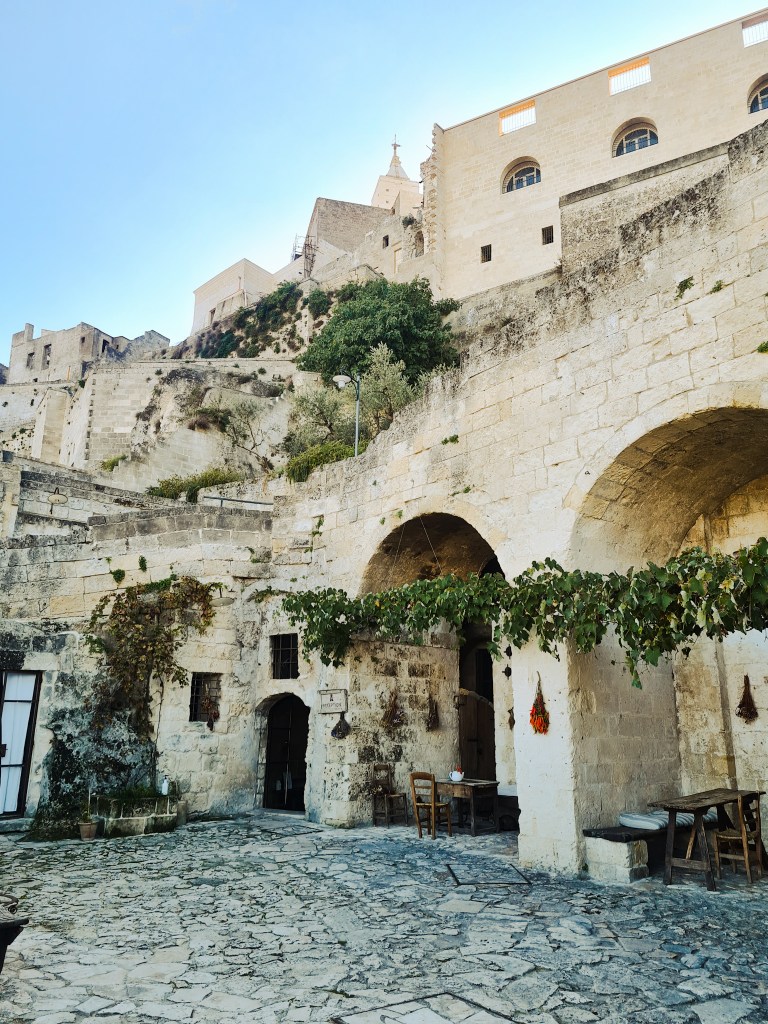
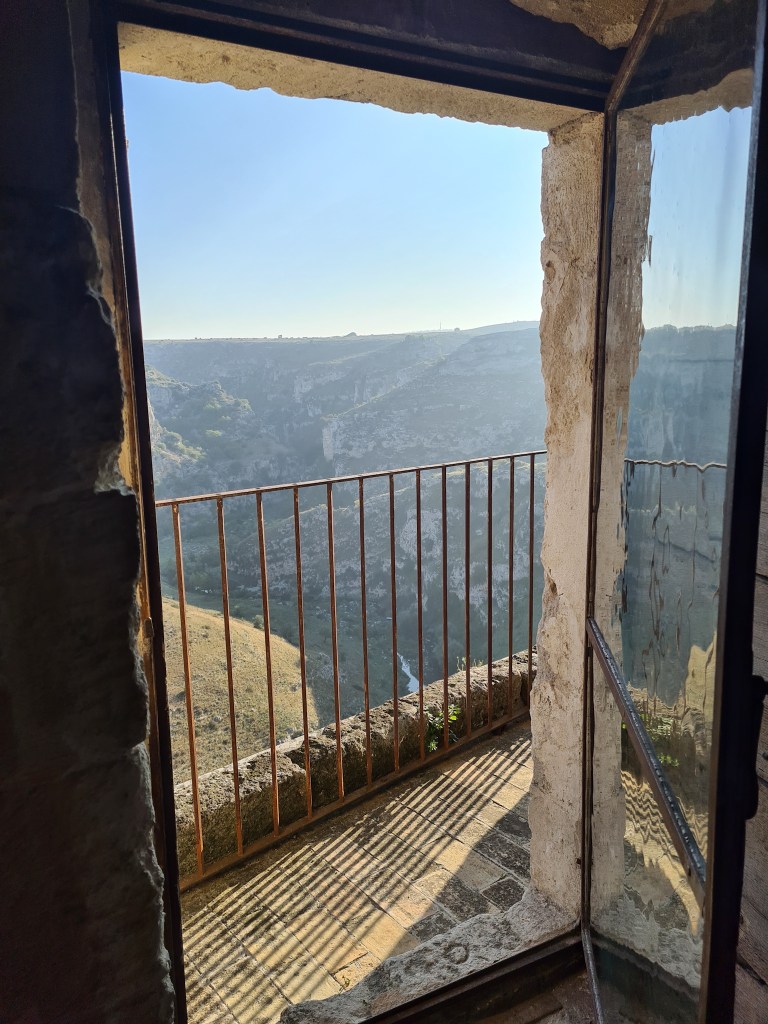
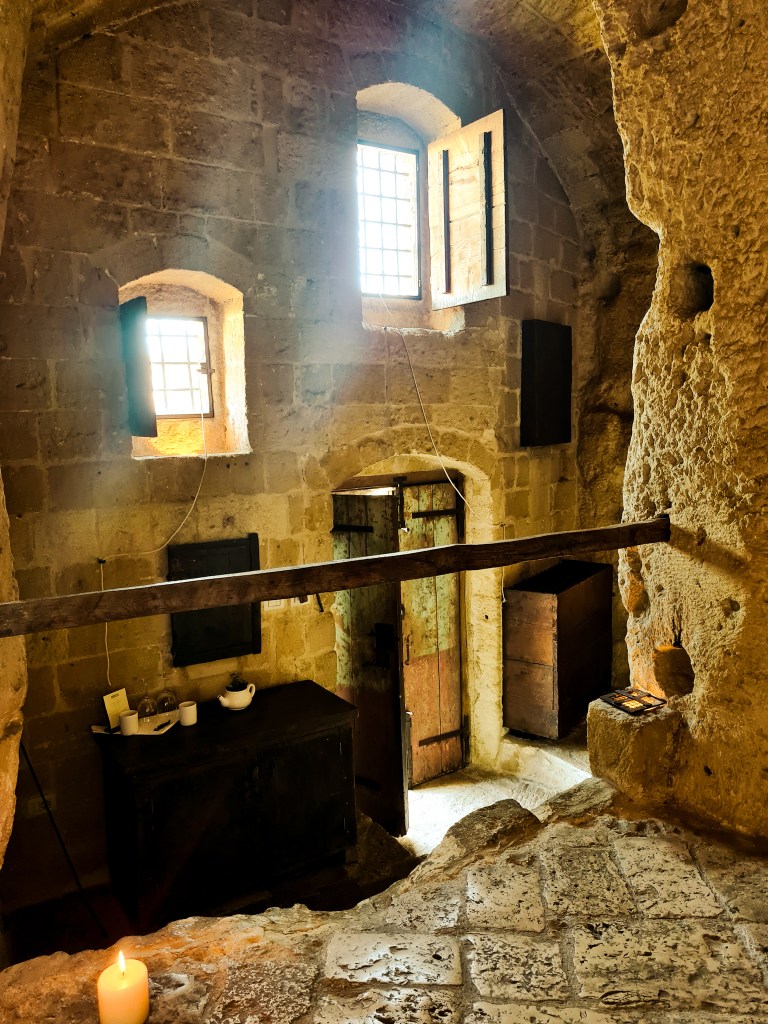
We’re fortunate to be staying in the best room in the house: cave 13, one of the executive suites (also known as the Bridal Suite). It’s a vast space split over two levels, with a separate living and dining space and the bedroom area has a balcony that looks straight over the national park below. We arrive at lunchtime, the sun splitting the skies outside, but the caves at le Grotte della Civita embody a different ambience altogether. Candles are lit are every turn, illuminating the stone of the cave in a warm glow. It’s highly atmospheric.
In a cavernous space like this, stretching deep into the hills, you’d expect the air to be cold and sterile. But Sextantio has managed the near-impossible, creating rooms that are welcoming in a way that is almost spa-like. Our guide tells us about the painstaking process of lifting the original stones on the floor and replacing them exactly to enable installation of underfloor heating that keeps the caves at a comfortable temperature all year long while protecting the historical features.
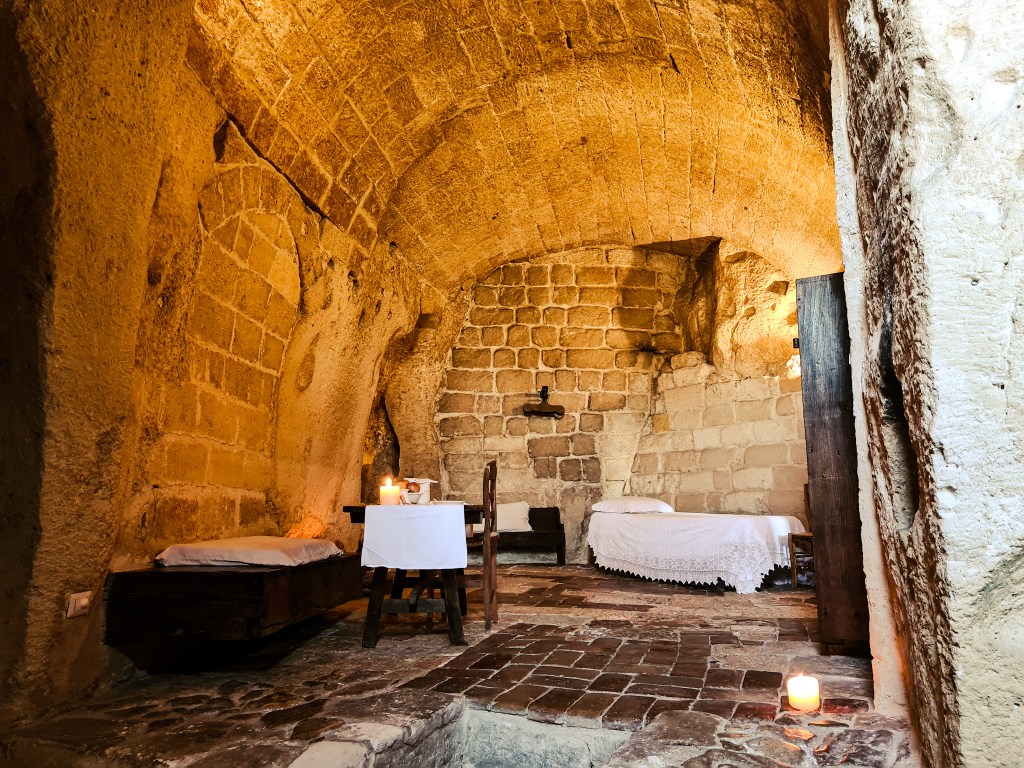
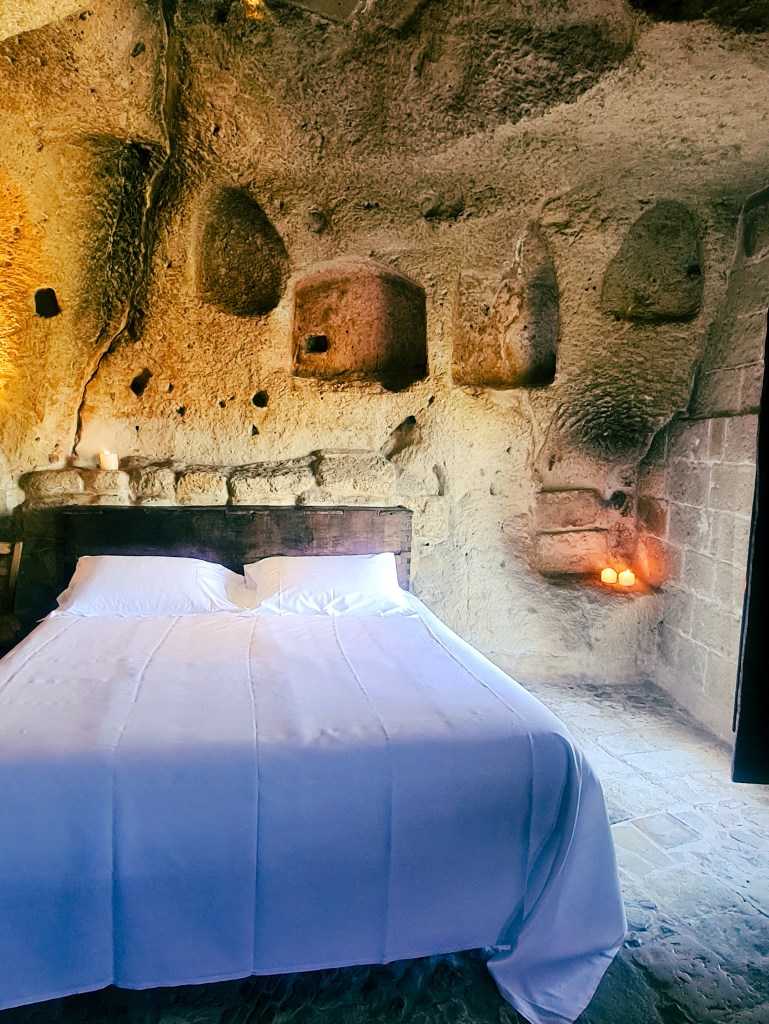
These caves would have housed entire families in the past, and today they are still designed as complete living spaces. The decor is rustic Italian style with wooden furniture and white linens. The dining table is ready-laid with a white tablecloth and two place settings. An old armoire doubles as a coffee-making station, seamlessly blending the modern conveniences of a luxury hotel into the historical backdrop. The room with toilet and sink (separate from the bathroom) is tucked into a far corner of the cave, hidden away with all of the amenities you would expect from a five star hotel: hairdryer, robes, slippers, toiletries.
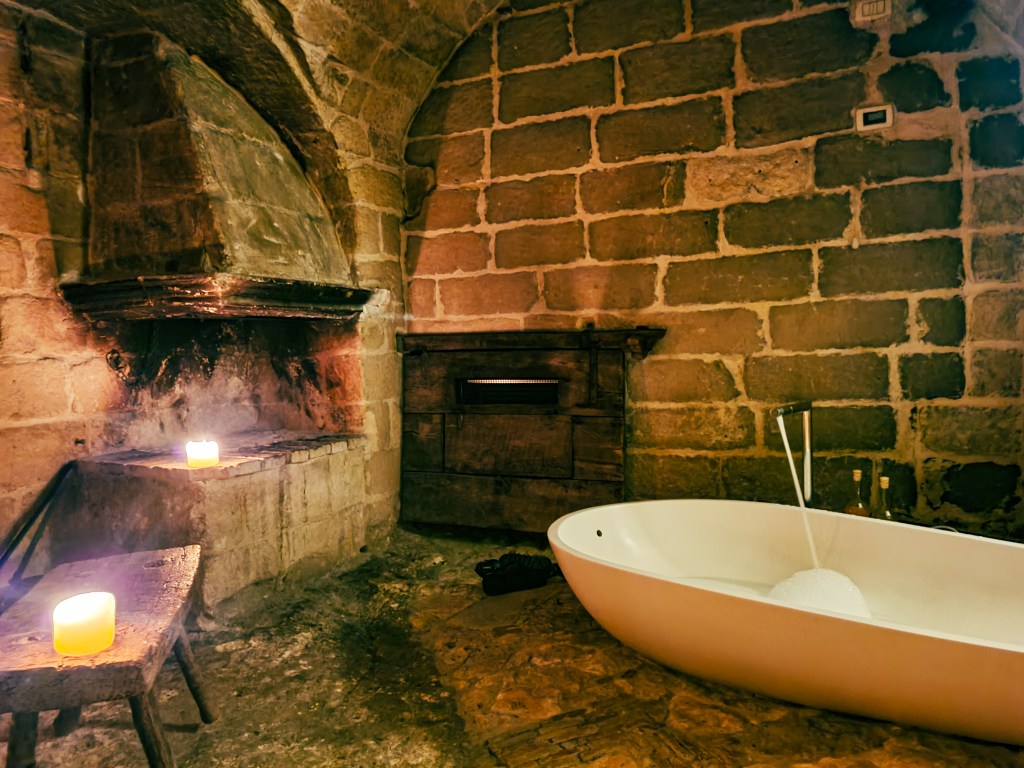
A favourite corner of the suite is the bathroom, featuring a large bath sunk into the stone floor and a working fireplace – all the necessary ingredients for a very cosy experience.
Importantly, the substance matches the style at le Grotte della Civita; the service is impeccable. We return to our room after a day of exploring to find that an evening turndown service has taken place. The bed is ready prepared for sleep and candles have been relit to provide a warm welcome back.
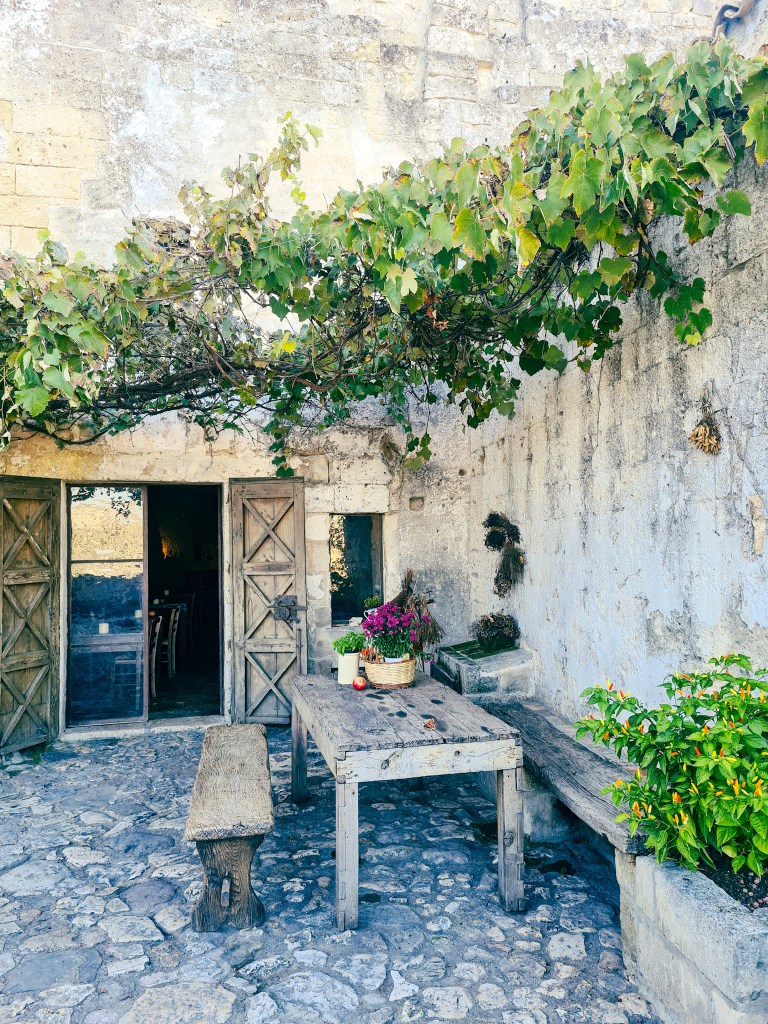
As the sun sets over the ravine and everything turns pink, le Grotte della Civita is transformed once again. Wooden tables on the outdoor terrace area enjoy prime position overlooking the valley, each decorated with freshly lit candles. These ubiquitous candles are so important to creating the ambiance at le Grotte della Civita that branded version are available to buy from the reception gift shop. We enjoy an evening glass of wine on the terrace to the soundtrack of church bells pealing in the distance. It’s magical.
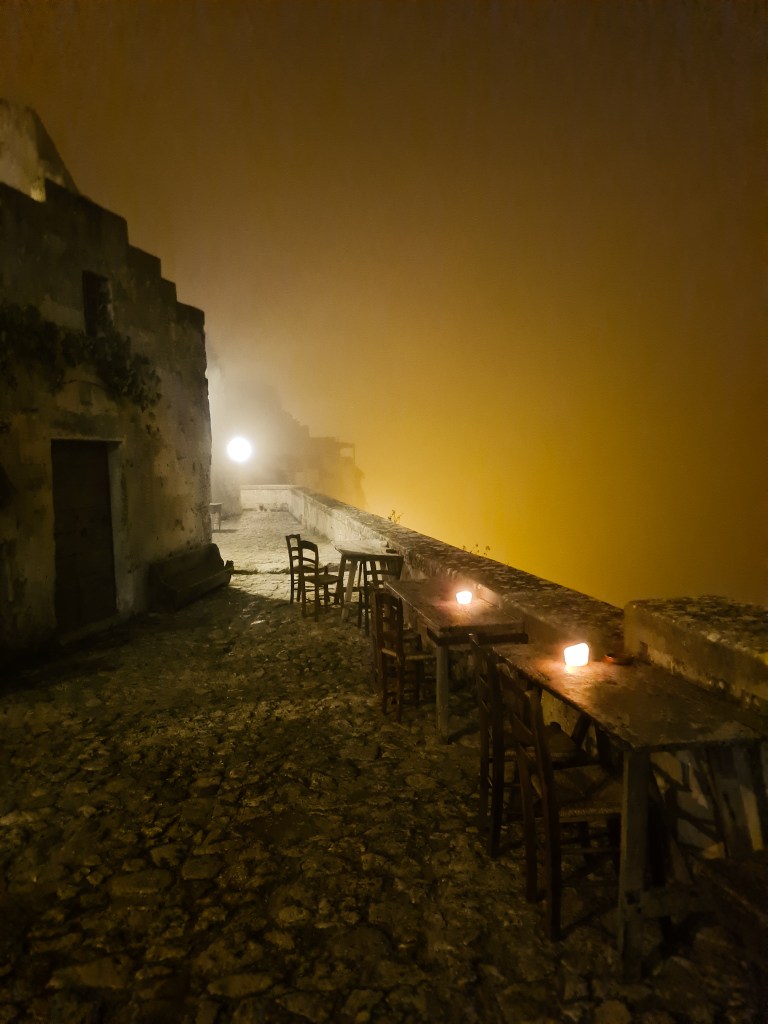
That evening, we are also treated to an unexpected natural phenomenon as a thick fog falls on the city, obscuring everything more than a few metres in front. The ravine has all but disappeared and the streets empty as locals head home to wait for the fog to lift. The only sign of life around is the light from the candles on the terrace of Grotte della Civita, abandoned like the Marie Celeste. It’s a comforting reminder that the team is on hand and ready to welcome you back.
Morning brings a completely different scene as sunlight floods in through the window of the executive suite. From the balcony we can see for miles over uninterrupted national park, and down below guests are beginning to enjoy breakfast on the terrace.
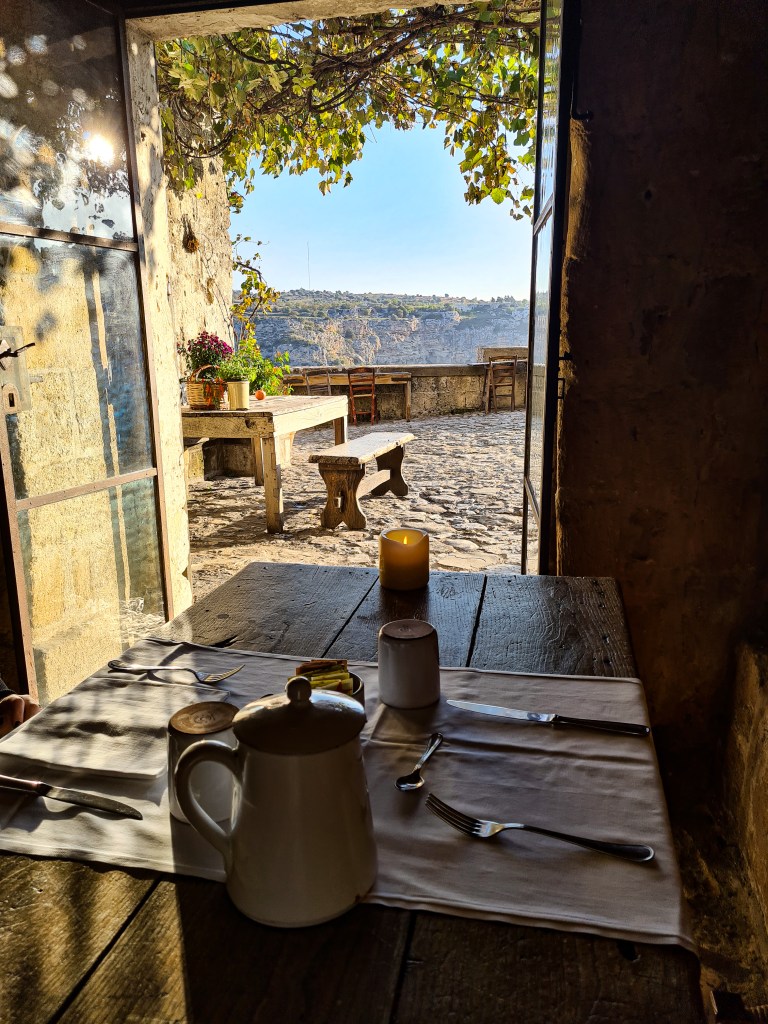
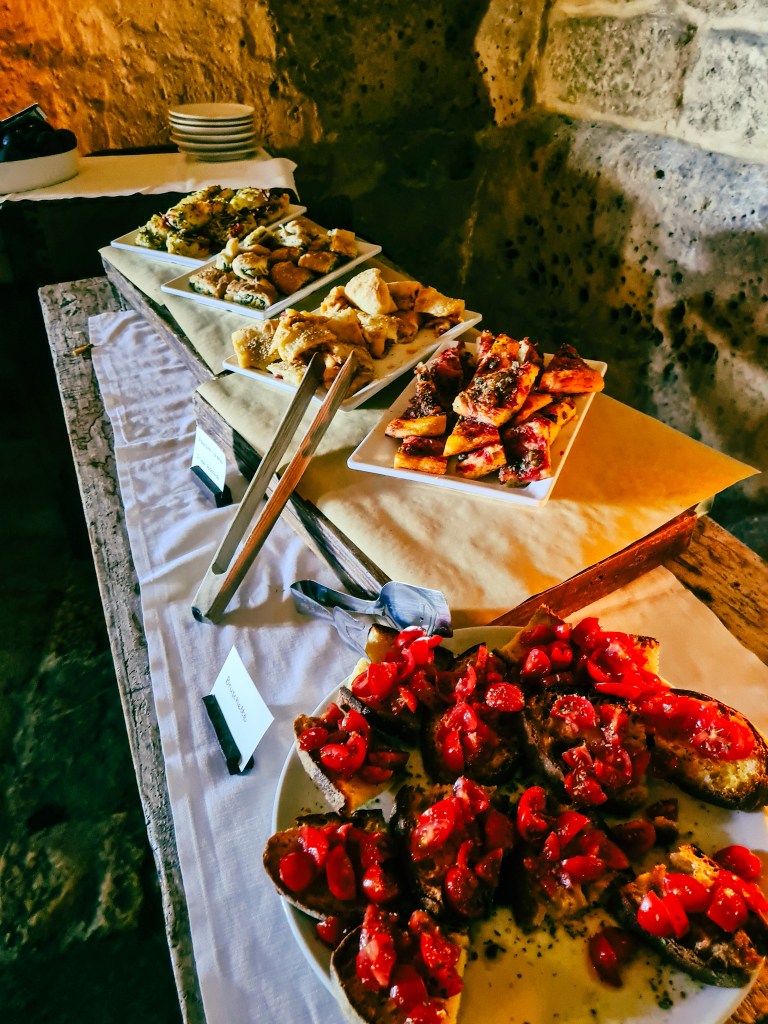
We choose to dine in the converted chapel building, which is prepared with several tables offering a wide variety of local breakfast treats, sweet and savoury.
One table is entirely dedicated to different varieties of focaccia: tomato and oregano, ripiena with spinach and cheese, and bruschetta, which is truly the dish we didn’t know we needed at breakfast time. An entire table is dedicated to freshly baked sweets and cakes like ricotta cheese pie, torta al caffè and orange frittelle. There is a host of continental options, including dedicated tables for cheese and charcuterie, as well as fruit and cereals. We drink fresh coffee and take in the vaulted ceilings of our surroundings.
It feels almost painful to close the door of Cave 13 behind us, thus bringing a close to our metaphorical visit to the past. This has been a stay like no other in a place like no other. It is palpably clear that the Sextantio team has done everything possible to honour and respect the history of the hotel and has carried out its restoration with such attention to detail that guests feel warmth and comfort in a setting that, by its very nature, should be anything but. Sextantio has succeeded in striking the perfect balance between preserving a heritage site and offering guests a luxury hotel stay.
The experience of staying in an original cave in Matera is one that we’ll never forget, and le Grotte della Civita is the best, most authentic, and most welcoming way to do it. We hope to one day walk back down the stone steps of the old town and catch a glimpse of those candles in the distance, welcoming us back.
We stayed
in Cave 13, the Executive (Bridal) Suite, priced from around €450 per night including breakfast in low season
This was a press stay – all opinions are our own
Discover more from
Subscribe to get the latest posts sent to your email.
 thewanderluxe.co.uk