One Saturday evening, we arrive at a quintessentially French 14th-century building in Paris’s Jewish quarter to visit a restaurant that serves Ashkenazi cuisine from Eastern Europe in a setting designed to look like a Russian summer house. Still with us?
It’s a niche concept, granted, but one that has every table full and the airwaves reverberating with the constant rumble of merriment, cutlery and toasting glasses. Boubalé is literally buzzing.
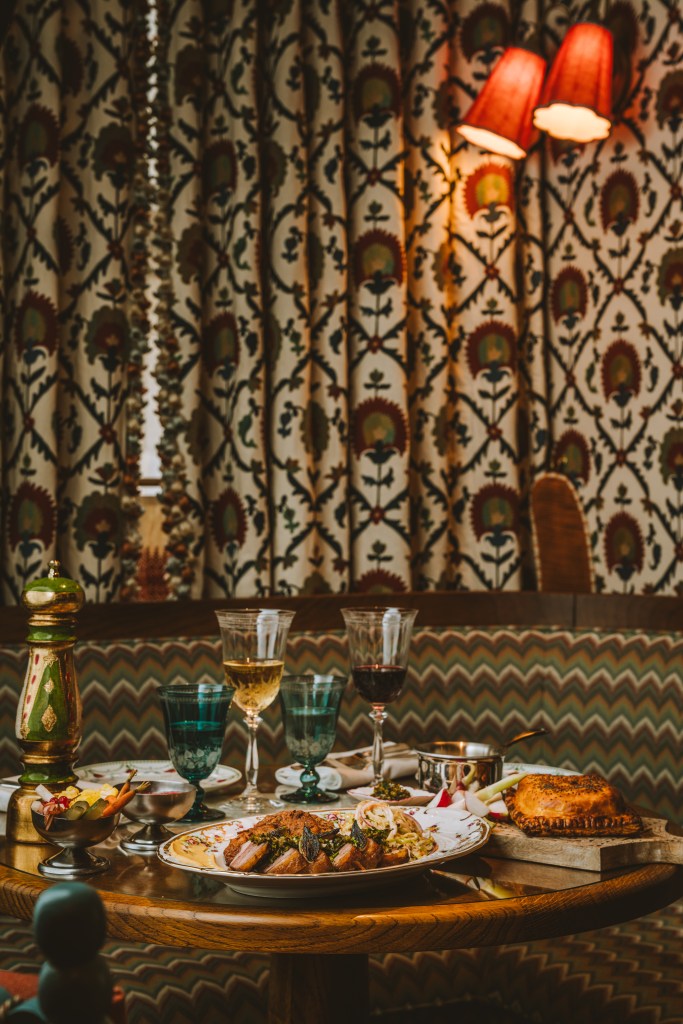
The restaurant has only been open for a couple of months at the time of our visit, situated within Le Grand Mazarin hotel – the newest opening from the Maisons Pariente hotel group. It’s a festive ambience, with constant streams of people wafting in from the street, the bar queued two-deep with people hoping to get a table, and a poppy soundtrack that could result in spontaneous dancing at any point.
We take a moment to devour the surroundings – and there’s a lot to take in. Like its parent hotel, bold and daring design is the order of the day. While Le Grand Mazarin is a saccharine otherworld of pastels and classic French design, Boubalé takes a step back in time and veers east, towards the forests of the former Soviet Union. The interior at Boubalé is designed to resemble a Soviet dacha, or summerhouse, where entire families would decamp to escape the oppressive heat of the cities and enjoy the peace of the countryside. Invariably, these trips would involve many a spirited meal around the table, and the inevitable cracking open of a bottle of vodka.
It is exactly this spirit of occasion that Boubalé endeavours to create, and the charming surroundings aid the intent; chintzy florals cover the entirety of the walls – it’s like eating under a patchwork quilt – with matching curtains that are drawn as though you’re visiting someone’s house. Traditional-style wooden furniture in contrasting duck-egg blue and orange are adorned with tiny bows; tables are laid with etched glass goblets and the sort of mismatched delicate crockery you might find in your grandmother’s display cabinet.
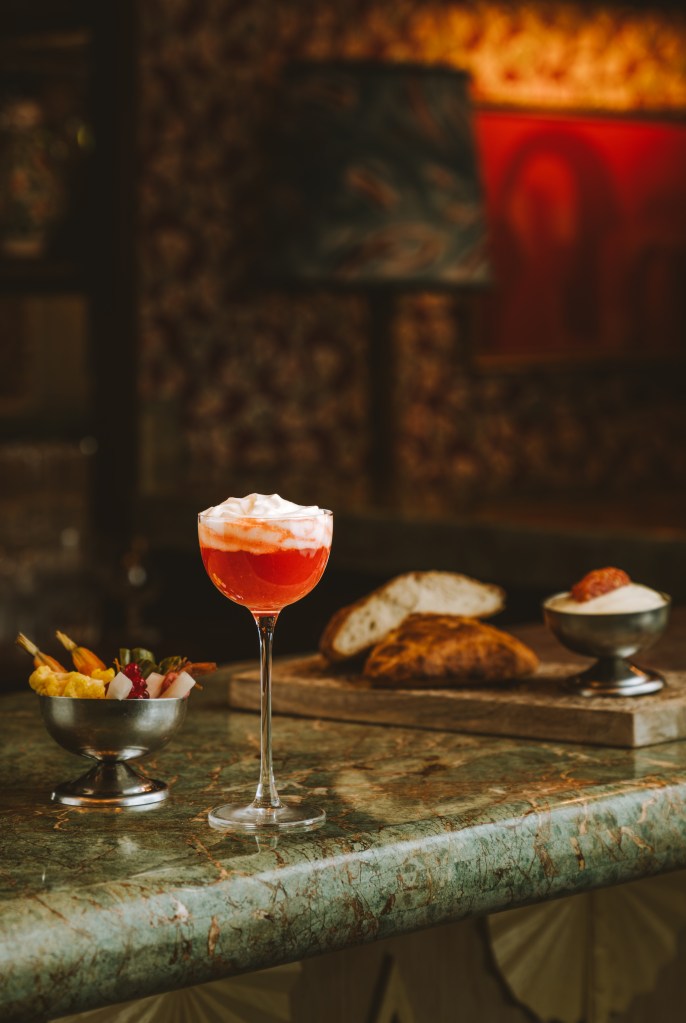
Our waiter recommends starting with a cocktail, and we order the house signature: a Chouchou (‘darling’ in French, which is a loose translation of the Yiddish ‘boubalé’ – borrowed from the Ashkenazi grandmother’s vernacular). It should be sweet – a misleading goblet in baby pink – but has the unmistakable tang of the beetroot from which it takes its colour. Through a curtain to the side of the dining room is the Boubalé bar, where it’s strongly suggested we make our way after the meal.
Rather than feeling rushed to finish dinner and clear the way for the next guests, you feel encouraged to make a night and to fully embrace the ‘kitchen dancing’ culture of dacha life.
The cuisine is particularly niche; Boubalé’s menu is hard to put your finger on, but is a delightfully messy amalgamation of family secrets and recipes that have travelled miles and been passed down through generations. By its simplest definition, it’s Ashkenazi, meaning Jewish cuisine originating in central and eastern Europe. These dishes were historically transported by grandmothers leaving their homelands in places like Ukraine, Poland, and Germany, and heading east to Israel, where the recipes were enhanced with the richness of middle eastern recipes and tastes.
At the helm of this complex gastronomical concept is chef Assaf Granit, formerly of the Michelin-starred Shabour in Paris’s Bonne Nouvelle neighbourhood. Together with his team, Granit has created a sophisticated and daring menu that fuses the nostalgia of his childhood with evergreen favourites from middle eastern cuisine. The kitchen is open and visible, allowing guests access to the sights and sounds of this creative process in realtime.
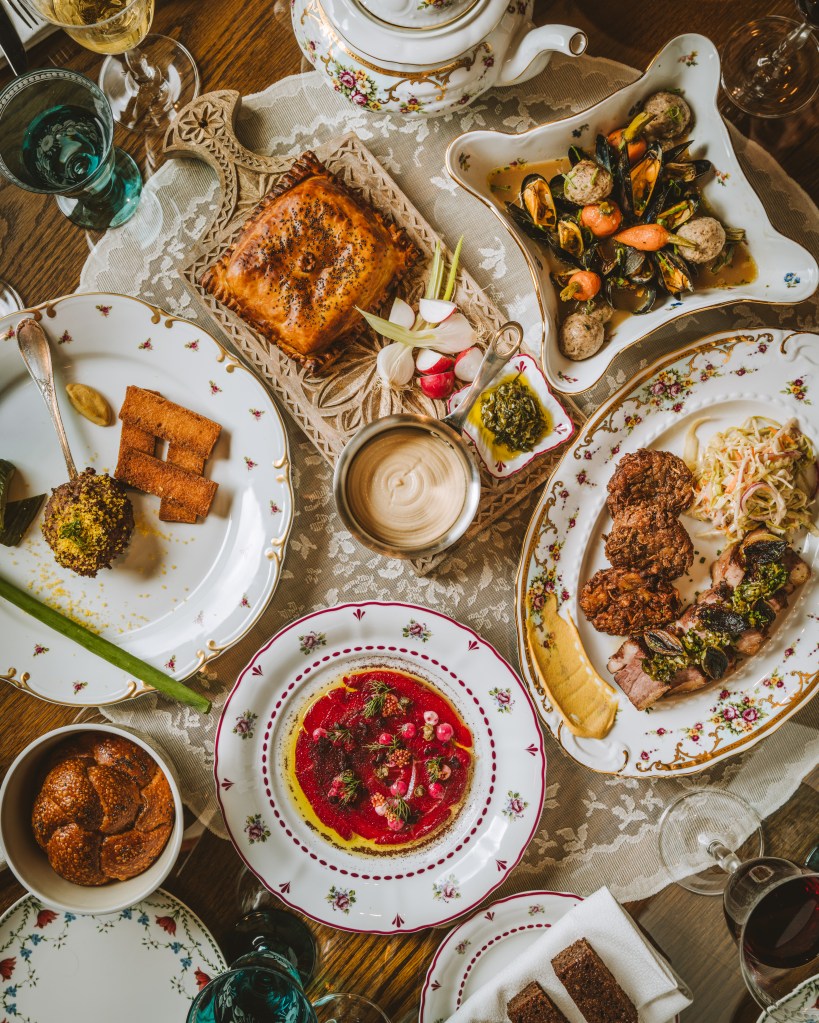
We start with challah, a warm round of braided bread with the glazed exterior of a bagel and a fluffy interior when pulled apart by hand (a requisite). We ask for starter suggestions, and our waiter recommends two of his favourites: the salmon grave-laks features the flavours of the classic Nordic version – dill, mustard, capers, roe – but takes a departure east with the addition of beetroot and the sharp tang of arak – aniseed grape brandy from the Levant. The Selek-Svekla is a light salad of beetroot, feta cream and horseradish – an excellent dipping accompaniment for the remaining bites of challah.
The faux eastern surroundings belie the fact that this is still France, and therefore it goes without saying that Boubalé has a selective but impressive wine list – from French classics to more unusual eastern flavours. We pair our main courses with one of each: a rich French red for the meat, and a crisp Lebanese white for the fish.
Everything here is designed to make guests feel like part of a story, and the dishes on the menu are no exception. Names like ‘Abigail’s Mantu, ‘Kurdish Lost in Poland’, and ‘Like a Jewish Wedding’ create a fun and accessible narrative that makes for an immersive experience without being remotely pretentious.
It’s impossible to resist the ‘Goulash + Gnocchis = <3’, which does exactly what it says on the tin: hunks of succulent slow-cooked beef swathed in almonds, herbs and parmesan, and with potato dumplings dotted throughout. There is something very satisfying about the contrast of eating a hearty stew-like dish that packs a punch from the most dainty and delicate floral crockery – just like grandma’s house.
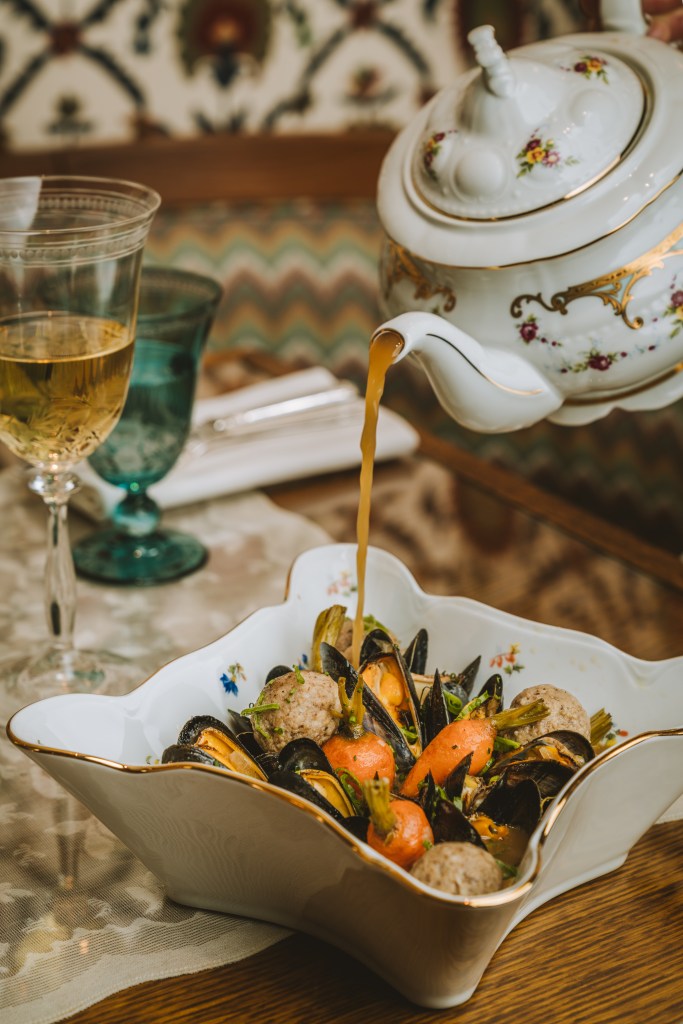
The Seafood Kneidlach is a deep, soup-like dish with lobster, mussels, prawns and Matzah ball dumplings in hamud (Lebanese broth flavoured with lemon and mint), which is theatrically poured live at the table from a china teapot. The kneidlach soak up the moreish tang of the broth, and we feel inclined to order more challah to mop up every last drop.
The atmosphere is peak Saturday night, and more and more tables are finishing dessert and heading round the corner to the bar. We’ve been served by several different members of the team tonight, all of whom are ready to give an explanation, correct pronunciation, and make recommendations where needed. It’s a nice touch that the menu lists the names of all waiting, kitchen and front-of-house staff, signalling a familial atmosphere.
It’s almost time for us to make our own journey to the bar to begin the proverbial kitchen dancing, but before that we order dessert. There’s the Lorimer St cheesecake – named for the street in Williamsburg, New York, where many Ashkenazi immigrants settled after the war. It’s a safe and classic New York cheesecake – you can’t go wrong – but it feels a little ordinary after the bolder combinations we’ve enjoyed in the other courses. Fortunately, the Babka Benimousse – the restaurant’s signature dessert – restores the magic; it’s a slice of sweet bread, similar in style to panettone, atop which sits an overly generous dollop of the richest chocolate mousse. It is sweetness overload, in the best possible way, and the ideal precursor for the bitterness of the arak shot that arrives with our bill.
Our dinner at Boubalé has felt like an almost theatrical experience – one where we’ve been transported to another place and time, and invited to sample an unfamiliar piece of gastronomic history. The flavour combinations are distinctive and personal, representative of nostalgia for family and summers spent together eating grandma’s food. It doesn’t matter if it resembles your own experience or not – you’re made to feel part of the family.
The curtains are still drawn and the party is in full swing. The bar is calling.
We ate
Challah served with crème fraiche and tomato – €10
Selek-Svekla (beetroot and feta salad) – €16
Grave-laks (cured salmon) – €28
Goulash + Gnocchis = ❤ – €34
Seafood Kneidlach – €38
Lorimer St cheesecake – €12
Babka Benimousse – €17
Boubalé is very popular, so you’ll likely need to reserve on weekends. Make a booking directly through their website.
This was a media visit – all opinions are our own.
Photographs courtesy of Grifco Public Relations
Discover more from
Subscribe to get the latest posts sent to your email.
 thewanderluxe.co.uk